


A battery energy storage system (BESS) can report 65% state of charge (SOC) while its energy management system (EMS) continues issuing discharge commands based on an outdated power limit. The BMS may have reduced allowable discharge current because of cell temperature, but the updated value never reached the supervisory controller.
This is not necessarily a fault of the battery. This can be because of wrong Modbus register map, delayed polling or communication failure between independent controllers.
A Multi-Protocol Industrial Gateway helps integrate BMS, PCS, EMS, and metering equipment through a common data interface. For storage applications, the engineering priority is preserving data meaning, freshness, and control boundaries across different industrial protocols.
1. Where Does the Gateway Fit in BESS Architecture?
A BESS typically has multiple controllers with different communication responsibilities.
| Equipment | Common Interface | Data Exchanged | Integration Risk |
| BMS | Modbus RTU/TCP, CAN | SOC, SOH, cell temperatures, current limits | Incorrect scaling or stale operating limits |
| PCS | Modbus TCP, vendor-specific protocols | AC/DC power, status, charge/discharge commands | Reversed power direction or invalid setpoints |
| EMS | Modbus TCP, OPC UA, IEC 61850 | Dispatch schedules, equipment availability | Command conflicts and outdated measurements |
| Power Meter | Modbus, DL/T 645 | Active power, energy, grid measurements | Inconsistent timestamps or energy counters |
Protocol availability varies by equipment manufacturer and firmware.
A gateway can acquire Modbus data from field equipment and publish selected points through MQTT or OPC UA. It should not replace direct safety-related communication between the BMS and PCS.
If the battery controller only exposes CAN, a gateway without the required CAN interface or driver needs an additional compatible communication device.
2. How Should BMS and PCS Data Be Mapped?
Certain registers require more attention, such as SOC and SOH. It is necessary to verify the scaling and valid ranges. It should be determined if the values are for individual cells, strings, or the entire battery. The same consideration must be taken for charge/discharge limits for the engineering units, conventions, and the direction of the limits.
For 32-bit measurements, there must be agreement on the interpretation of the register (e.g., signed, unsigned, floating point, and byte order) as well as the order of the registers.
•Faults states must also be distinguished in an appropriate manner.
•Data timestamps must also be linked with the measurements.
In cases where IEC 61850 is the only communication standard available for integration, defining the logical nodes, client/server roles and data models are as important as protocol verification and implementation of communication services.
3. Can the Gateway Meet BESS Data Update Requirements?
A shared RS485 network can become a significant bottleneck when there are many polled devices and a short polling interval.
Each Modbus RTU request adds transmission time, device processing time and turns around time for the bus. Retries after communication errors increase the time between consecutive valid requests.
Using a polling strategy, we determine the importance of each category of data:
•Frequent update: Available real power limits, operating status of PCS and supervisory critical measurements.
•Event-based: Communication faults, protective shutdown indications, and fault transitions.
•Lower-importance: Accumulated energy, maintenance counters and routine diagnostics.
Polling intervals must be determined from the maximum allowable age of the data and measured performance of the system, rather than from the fastest permissible time.
A 5G uplink will not help if the Serial bus is too loaded.
Handling Cellular Outages
For remote BESS installations, loss of connectivity should not cause older values to be reported as newer values.
Where needed, specify that gateways have buffering and time-stamping as well as store-and-forward behavior. Make sure these functions are present in the firmware of the selected gateway.
After the reestablishment of connectivity, the Supervisory system should identify Historical Records and report any out of order or duplicate measurements.
4. How Should Remote Commands Be Protected?
Monitoring battery data and remotely changing PCS power setpoints require different security controls.
Modbus provides no inherent authentication or encryption. Connecting writable registers to external networks without access restrictions creates a direct operational risk.
For a BESS gateway, the communication design should provide:
•VPN protected remote connections and segmentation of the OT network.
•Explicit separation of read-only monitoring and control.
•Command validation, acknowledgement and timeout processing.
•Rejection of commands based on stale measurements and/or invalid equipment state.
Local BMS and PCS protection should not be dependent on cloud connection. Gateway failure should not result in loss of battery protection, emergency shutdown functions and/or equipment operating limits.
5. Choosing a Tespro Multi-Protocol Industrial Gateway
At Tespro, we suggest evaluating the project's protocols, physical interfaces, communication topology and remote access needs, and then deciding on the most suitable gateway.
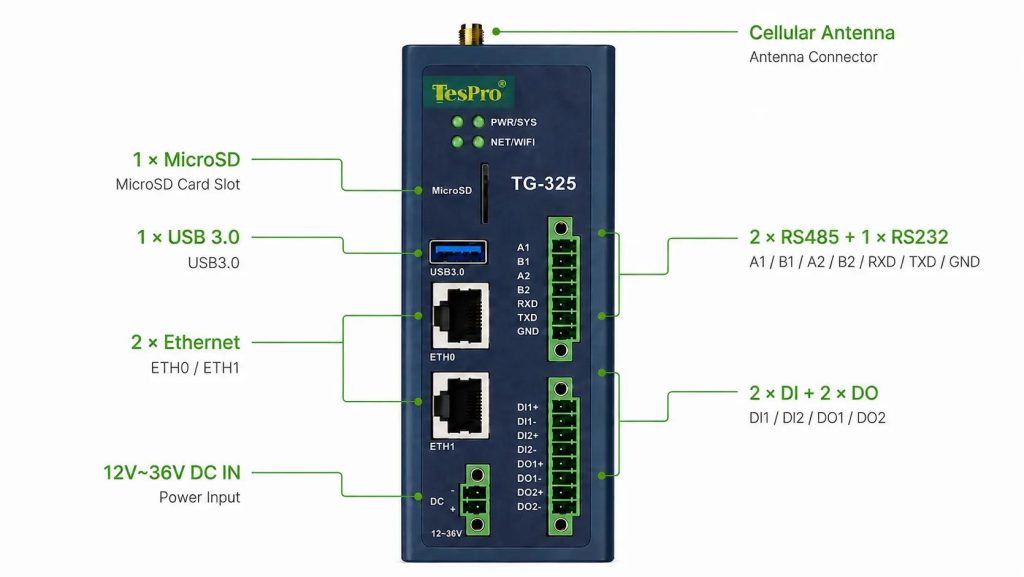
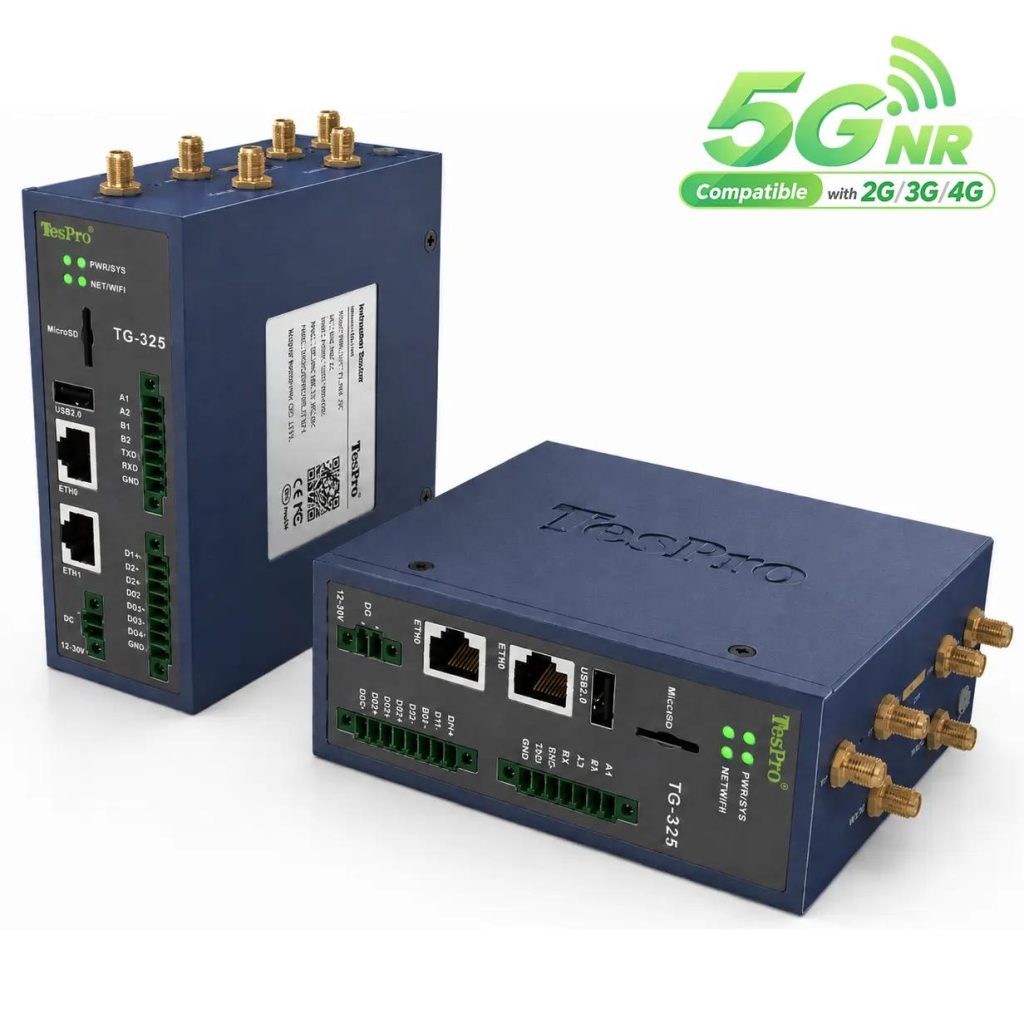
Our TG-324 and TG-325 industrial gateways provide relevant hardware and software options for evaluating BESS data integration.
| Selection Criterion | Tespro TG-324 | Tespro TG-325 |
| Cellular Connectivity | 2G/3G/4G | 2G/3G/4G/5G |
| Serial Interfaces | 2 × RS485, 1 × RS232 | 2 × RS485, 1 × RS232 |
| Ethernet | Gigabit WAN + LAN | Gigabit WAN + LAN |
| Industrial Protocols | Modbus RTU/TCP, OPC UA, IEC 61850 listed | Modbus RTU/TCP, OPC UA, IEC 61850 listed |
| Remote Management | TesproOS, VPN | TesproOS, VPN |
| Typical Selection Consideration | Sites using 4G backhaul | Sites requiring 5G connectivity |
Both models offer MQTT connectivity and protocol-conversion functions. Their actual interoperability with a particular BMS, PCS, or IEC 61850 implementation requires verification.
The TG-325 is worth evaluating where 5G coverage and network requirements justify it. However, higher cellular bandwidth does not automatically improve BESS monitoring accuracy.
For either model, confirm supported protocol roles, simultaneous protocol operation, register capacity, firmware version, and any required offline data-retention functions before ordering.
6. What Should Be Checked before Acceptance?
At a minimum, Representative BMS and PCS hardware or validated simulators should be used for a Factory Acceptance Test (FAT).
There are 4 tests to identify integration failures:
• Register Accuracy: SOC, voltage and power limits and faults, compare against the source controller, check for negatives. Perform Word Order and Scaling checks.
• Communication Loading: Check for polling completions and timeouts, verify behavior of connected devices.
• Network Interruption: Disconnect the uplink. Verify stale data is cleared, check behavior of historical data if configured.
• Control Authorization: Check behavior of end-equipment, command authorization. Check for loss of communications and bypass of local protections.
The same checks are performed for data mapping, post relevant firmware updates.
For BESS projects with multiple equipment vendors, Tespro can review your interface requirements and suggest a suitable gateway configuration.
Check out Tespro Industrial Gateway Solutions or provide your equipment protocols for a technical review.
FAQs
Q1. What is a Multi-Protocol Industrial Gateway used for in BESS?
It connects BMS, PCS, EMS, and metering devices, converting industrial data for monitoring, supervisory control, and remote communication.
Q2. Which Tespro industrial gateways are suitable for BESS integration?
Tespro TG-324 and TG-325 are candidates for BESS communication projects. Selection depends on device protocols, interface requirements, and cellular connectivity.
Q3. What industrial protocols do Tespro gateways support?
Tespro TG-324 and TG-325 list Modbus RTU/TCP, OPC UA, MQTT connectivity, and IEC 61850. Specific protocol functions and compatibility require confirmation.
Q4. Can Tespro gateways connect directly to a BMS?
Yes, when the BMS provides a compatible interface, such as Modbus RTU or TCP. CAN-only systems require additional compatible communication hardware.
Q5. How many RS485 interfaces do Tespro TG-324 and TG-325 provide?
Both models provide two RS485 ports and one RS232 port for connecting compatible industrial controllers, meters, and monitoring equipment.


